Biosolutions beneath our feet: How fungi are rewriting roads and pavements
What if the materials holding our roads and pavements together didn’t come from burning fuel or melting rock — but from life itself?
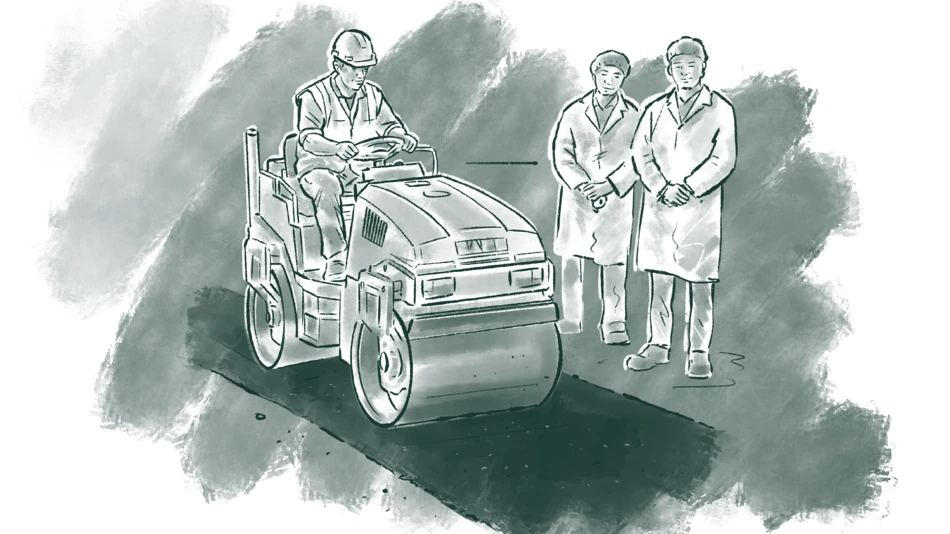
In conventional infrastructure, binders like cement and bitumen rely on force. Fungal binders work differently: they don’t need heat or chemistry. Instead, the fungus spreads through sand, gravel, and stone, weaving a dense, interwoven network that binds the particles together with strength born from entanglement and natural adhesion. It sounds almost magical — yet it is biology, not fantasy, quietly shaping the roads beneath our feet. Keep reading and let yourself be fascinated!
Disclaimer: Biosolutions Bulletin covers the full field, including innovations beyond Novonesis’ current commercial reach. This article looks at one such development—and a glimpse of the future: Fungi-built roads aren’t here yet, but the science is already underway.
The word fungus (plural: fungi) rarely inspires excitement. For many people, it suggests mold, decay, or disease, and not without reason. There are around 150,0001 known species of fungi, and roughly 300 are known to cause infections in humans, some of them even fatal2.
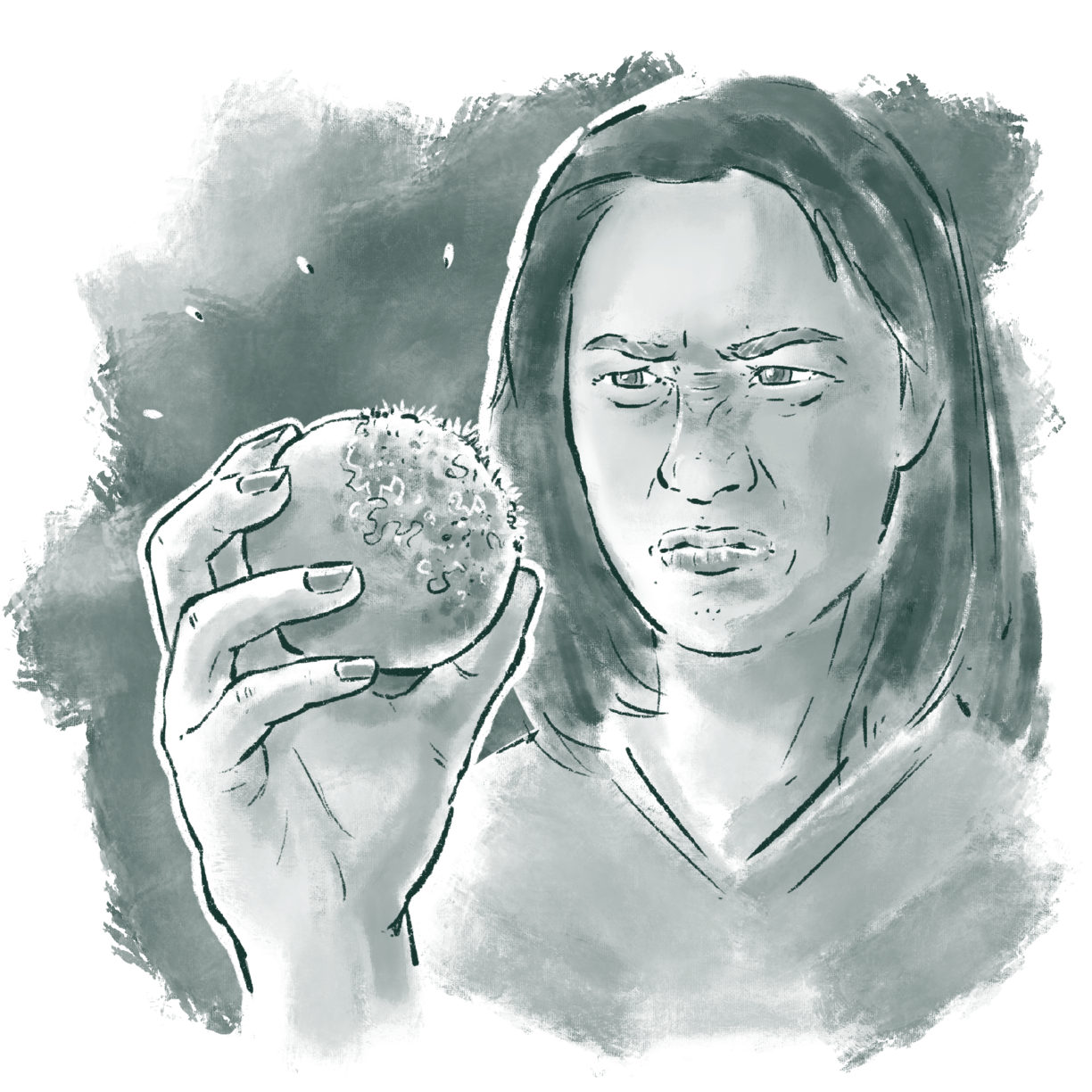
But fungi also have a very different side.
They have helped us develop antibiotics, bake bread, brew beer, and create alternatives to animal-based proteins. And now, they are showing up in a place few would expect: as binders in the construction of pavements and roads to replace cement and bitumen.
This is not a futuristic idea or a lab experiment. Products made from fungi already exist that can replace cement in pavement blocks and bitumen used in construction of roads. These materials are grown with the help of biological processes instead of fossil fuels and high-temperature industrial systems.
So how does a living organism like fungi end up becoming the raw material for strong, long-lasting infrastructure under our feet? To answer that, we need to start with the basics: what fungi actually are — and, most importantly, what mycelium is.
What are fungi, and what is mycelium?
Fungi are living organisms, just like plants, animals, insects, and bacteria. They are almost everywhere — on land, in water, in the air, and even on and inside our bodies. Some fungi are microscopic, meaning we cannot see them with our naked eyes. Others grow large enough for us to see, like the mold that appears on stale bread.
One important thing that sets fungi apart from plants is that they cannot make their own food. Like humans and animals, fungi must forage for food and consume it, and how they do this is quite fascinating.
First things first — in the case of fungi, the food they consume is called a substrate. While we chew food, swallow it, and digest it inside our bodies, fungi grow directly on their food to feed on it. After all, they do not have mouths, stomachs, or hands. That substrate can be almost anything: a fallen tree, damp wood, a forgotten loaf of bread, or even the soil beneath a forest floor.
So how do fungi feed on the substrate? They do not grow vertically like trees. Instead, fungi grow in the form of thin strands that wrap themselves in and around the substrate. Each of these individual thread-like strands is called a hypha.
The hyphae spread through the substrate, branching and weaving as they grow. Wherever they touch the substrate, they release enzymes that break it down into simpler forms that the hyphae can absorb as food.
If we compare this to how humans eat: we break food with our hands, chew it with our mouths, swallow it, and digest it with the help of enzymes. Fungi, on the other hand, spread their hyphae around their food, release enzymes directly onto it, break it down, and then absorb it.
As fungus grows older, it continues to spread its hyphae further through the substrate in search of food. Over time — especially in forest soils — these hyphae form a vast, dense, root-like, interconnected network. That network is called mycelium.
And the use of the word “vast” here is not an exaggeration. In fact, one of the largest living organisms on Earth is not a whale or a giant tree — it is a fungus.

If fungi make you uncomfortable, Oregon may not be for you. The world's largest fungus lives there, spanning more than 1,500 football fields!
A fungus that is scientifically named Armillaria ostoyae stretches beneath forests in Oregon across more than 2,300 acres. That is roughly the size of 1,665 football fields3. Scientists believe it has been growing for thousands of years.
Let’s dive into the fascinating phenomenon of mycelium — the hidden, thread-like body of the fungus that grows, spreads, and, as you’ll soon see, can bind materials in unusual ways.
Why mycelium?
At first glance, mycelium hardly looks like a material that belongs anywhere near construction. It appears thin, soft, and almost fragile — more like a tangled mass of roots than something capable of holding stones together or supporting weight. If you were shown mycelium and asked whether it could ever replace materials like cement or bitumen, your instinctive answer would probably be no.
After all, cement comes from limestone, a rock that has stood the test of time. Bitumen comes from crude oil, buried deep within the Earth and transformed under immense heat and pressure. Mycelium, by comparison, grows quietly in soil and wood, often out of sight. It does not look tough. It does not look permanent. And it certainly does not look industrial.
And yet, this first impression turns out to be misleading.
There is an important connection between mycelium, limestone, and crude oil that is easy to miss. All three are products of nature. But while limestone and crude oil are extracted and then heavily processed to unlock their usefulness, mycelium arrives with something already built in: a natural balance between strength and flexibility.
That balance is rare—and it is exactly what makes mycelium such a compelling candidate for use as a construction binder.
To see why, we need to zoom in.
This article is part of The biosolutions bulletin. Want it in your inbox every month?
At the microscopic level, mycelium is largely made of two natural carbohydrates: chitin and beta-glucans. These two materials play very different roles, but together they give mycelium its distinctive physical abilities that we can leverage in developing binders for construction out of them.
Chitin is the source of strength. It is a rigid and durable natural material that can hold its shape under pressure, best known for forming the exoskeleton (shells) of crabs, shrimps, and insects like locusts. In mycelium, chitin reinforces the thread-like fibers, giving them the ability to bear loads and resist deformation.
But strength alone is not enough. A material that is only strong, but not flexible, tends to be brittle. It can hold weight, but once pushed beyond its limit, it cracks or breaks suddenly. This is where beta-glucans come in.
Beta-glucans act as a binding and toughening agent, commonly found in plants, especially in cereals and grains such as oats, barley, wheat, and rice. In those grains, beta-glucans help tissues stay intact during milling, soaking, cooking, and drying by allowing them to flex and redistribute stress instead of breaking apart. In simple terms, beta-glucans help materials bend slightly, absorb shocks, and recover, rather than fail abruptly.
A useful analogy is to imagine bones that could bend slightly under pressure instead of snapping. They would still support weight, but they would absorb shocks and recover. That, in essence, is how mycelium behaves.
This ability to combine strength with toughness — rigidity with flexibility — is the unique ability of mycelium, which makes it a great natural product to be leveraged as a construction binder, holding materials together while enduring stress.

The ability to combine strength with toughness makes mycelium a great natural construction binder.
So how does mycelium turn into pavements and roads?
Imagine this. You tie a thin metal wire around the trunk of a young tree and leave it there. When you return a decade later, you find that the wire did not stop the tree from growing. Instead, the tree has grown all around it. The trunk has slowly wrapped itself around the metal, absorbing it into its body.
That is the simplest way to understand what a mycelium-based binder does — just much faster.
Earlier, you learned how fungi feed. They do not sit in one place and “eat” the way we do. They grow around their food, the substrate, and form mycelium.
In construction, the same idea is used, but in a controlled environment.
Instead of letting mycelium grow through forest soil or fallen wood, it is encouraged to grow through the same loose materials we use to build roads and pavements — aggregates such as crushed stone and sand.
And how does the mycelium find its way around these hard, mineral particles? By following food. Organic material — the substrate the fungi feed on — is spread throughout the mix. As the mycelium grows in search of this food, its thread-like strands expand in every direction, wrapping around whatever lies in their path.
So what does that look like in practice?
Picture a large tank or controlled growing environment. Into it go two broad ingredients:
- Food for the fungi (like agricultural waste or wood shavings)
- Aggregates such as sand, gravel, or crushed stone
Then selected fungal strains are introduced, and the fungi are simply allowed to do what they do best — grow.
As the fungi feed on the organic material, the hyphae spread in every direction. They creep through tiny gaps, cross over and under particles, and gradually wrap around the mineral pieces. Over time, the loose mix begins to behave less like a pile of stones and more like a single, interlocked structure, because a living network is forming inside it.
At the end of this growth phase, the fungi have consumed much of the food. What remains is something remarkable: a block of aggregates tightly held together by mycelium, with the binding coming not from heat or chemistry, but from growth.
Cement and bitumen come from nature too — cement from limestone, bitumen from crude oil. But they are not living. To turn them into binders, raw materials must be extracted and pushed through extreme industrial steps: very high heat, combustion, and chemical changes. Only then do they become materials that can glue sand and stone together.
Mycelium flips that logic. Cement and bitumen bind because we force them to. Mycelium binds because it grows. Once the desired amount of growth is reached, it is deliberately stopped, so it can no longer spread or form mushrooms (see fun facts below). What remains is no longer active, but it retains the structure created during the growth phase.

From growing binders to building roads and pavements
This is exactly the approach taken by Visibuilt, a startup based in Copenhagen. Visibuilt has developed a construction binder based on mycelium, known as visiBINDER. It can be adapted to different construction needs but the basic idea stays the same: use mycelium’s natural growth as the binding force.
Let us first look at the visiBINDER based pavement blocks, visiPAVER. In a conventional paver (blocks used in pavements), stones and sand are held together by cement and water. In the mycelium-based version, aggregates, filler, water, and the binder are shaped together. The mycelium grows through the block, locking everything together from within. Once strength is achieved, growth is halted, leaving a stable, usable pavement block.
The same principle applies to road construction. Instead of heating bitumen, aggregates are mixed with living fungal material, which gradually grows around the stones, weaving them into a solid network. Once this growth is complete, it is stopped, leaving behind a stable road surface so that it ends up looking like a road. But the binder is not oil-based bitumen and heat-driven. It is biological, grown into place, and then stabilized.
And now the bigger question becomes hard to ignore: if we can grow a binder instead of burning fuel to manufacture one, what does that change for the future of roads, pavements, and the carbon emissions tied to building them?
Why biological binders matter
When biological binders are placed next to cement and bitumen, the differences are hard to ignore.
- Producing cement requires heating limestone to around 1,450°C (2,642° F). Bitumen, too, must be heated to 160–200°C (320–392° F) before it can be used for road construction. Mycelium-based binders operate on a very different scale — typically between 25 and 120°C (77–248° F) — because their strength comes from biological growth rather than extreme heat. Less heat means less energy, and that matters in an industry still heavily dependent on fossil fuels.
- Where these materials come from also matters. Cement production relies largely on coal-fired kilns. Bitumen is derived directly from oil, tying roads to global oil markets and a small number of exporting regions, making it sensitive to price volatility, and geopolitical vulnerability.
- There are benefits on the ground as well. Traditional cement and asphalt work involves high temperatures, heavy machinery, and exposure to toxic fumes. Biological binders avoid many of these hazards simply because they do not require extreme heat or harmful chemicals to function.
Taken together, these differences point to more than a new material. They raise a deeper question: why are cement and bitumen so central to modern construction in the first place—and what challenges are now forcing that reliance to be reconsidered?
If you’re curious, our article “Rethinking the materials that hold the modern world together" steps back to examine how today’s construction industry came to depend so heavily on these binders, and why their fossil-fuel foundations are increasingly under scrutiny.
At the same time, these differences point to a different way of thinking about infrastructure itself. Biosolutions like mycelium-based binders show that performance does not have to come from extraction, combustion, and force. It can come from biology—grown rather than manufactured, local rather than imported, and shaped by biological processes rather than extreme heat. Beneath our feet, roads and pavements may still look the same. But the way they are made—and the systems they depend on—can be fundamentally different.
How the smallest threads hold everything together
A single hypha — the basic thread that makes up mycelium — can be as thin as 0.5 micrometers (µm) and up to 20 µm wide. To picture that scale: 0.5 µm is about 200 times thinner than a human hair, while 10–20 µm is roughly the size of a red blood cell.
Mycelium in shoes, fashion, and packaging
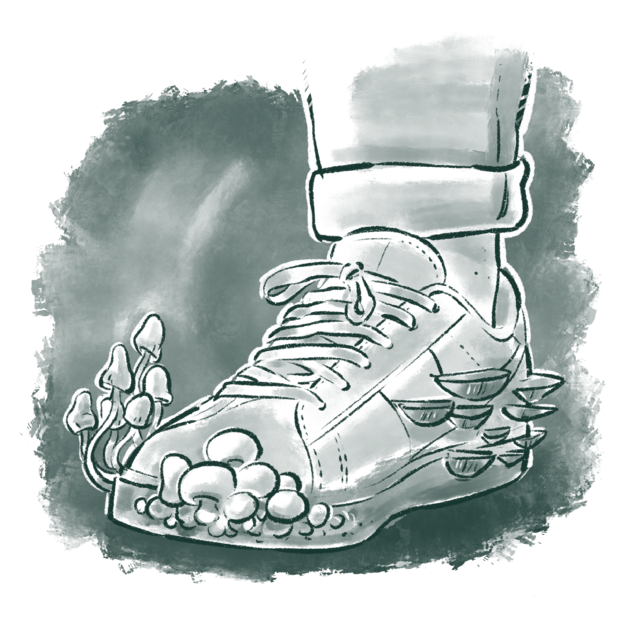
While mycelium has made its debut in the construction industry, it is also being used to make leather-like fashion materials, compostable packaging, insulation panels, and even sneaker soles. In most cases, it replaces plastic or animal product with a material that is grown, not manufactured.
How do mushroom fit in?
You might wonder where mushrooms fit into all this. Like all living things, fungi need to reproduce. They do this by producing tiny, single-celled units called spores. When the time is right, the mycelium creates a mushroom. This mushroom grows above the surface and releases spores into the environment. In simple terms, mushrooms are not the fungus itself. They are temporary elevated structures that fungi build for reproduction. Yum!

Rethinking the materials that hold the modern world together
To understand why biological binders are such a game-changer, we must first look at the materials they are replacing. We explore how cement and bitumen came to dominate human history—from the Roman Empire to modern highways—and why their heavy reliance on fossil fuels is now under scrutiny.
What is a biosolution?
Microbes and enzymes are tiny but mighty agents of change. For billions of years, they’ve enabled transformation in all living things through microbiology.

All you need to know about biosolutions, delivered monthly
Biosolutions are fascinating but can be difficult to grasp. That's why we created the monthly Biosolutions Bulletin — to break down the science into easy-to-understand, engaging stories with beautiful hand-drawn illustrations.
Each issue dives deep into the science behind biosolutions and their roles in transforming everything from agriculture to industries and the products we use every day.
Sign up today to stay updated!
One more step…
To complete the get in touch form or sign up, please click on the button below to enable cookies.
References
1. The numbers of fungi. https://link.springer.com/article/10.1007/s13225-022-00507-y
2. Antifungal resistance. https://www.imperial.ac.uk/Stories/antifungal-resistance/
3. The Largest Organism on Earth Is a Fungus. https://www.scientificamerican.com/article/strange-but-true-largest-organism-is-fungus/
Fun fact sources:
4. Hypha - an overview. https://www.sciencedirect.com/topics/agricultural-and-biological-sciences/hypha
5. Why mushroom mycelium could be your next house, handbag, or ‘hamburger’
https://www.weforum.org/stories/2020/12/mycelium-mushroom-sustainable-packaging-fashion-meat/