Rethinking the materials that hold the modern world together
The widespread use of cement and bitumen (the binding ingredient in asphalt) has shaped the buildings we live in and the roads we travel on, making modern infrastructure possible. But it has also created a deep dependence on fossil fuels and energy-intensive production.
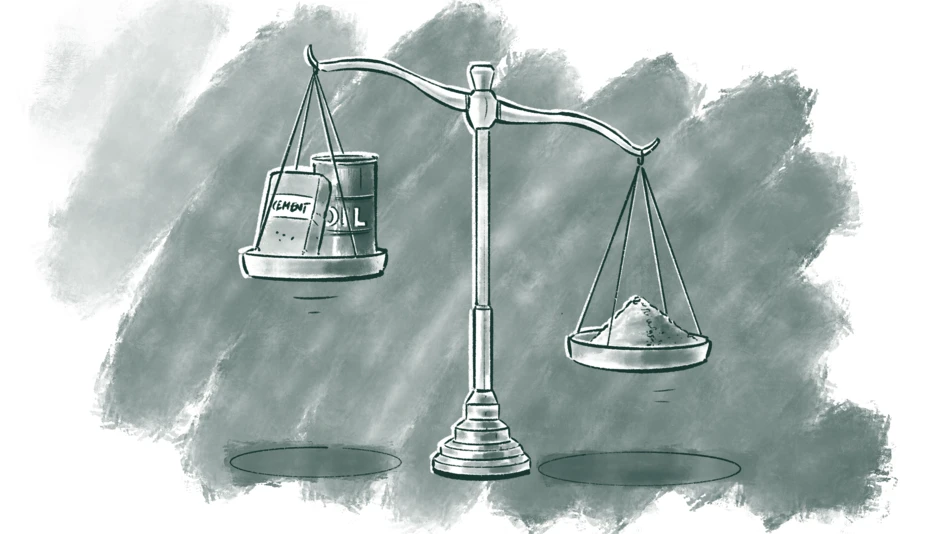
To appreciate why alternatives like those explored in “Biosolutions beneath our feet” are being considered, it helps to first examine how these conventional materials came to dominate — and the challenges that now accompany their continued use.
Across history, great empires have announced themselves in stone. The Pyramids of Giza still rise from the desert. The Colosseum still dominates the heart of Rome. The Taj Mahal and Machu Picchu continue to draw people from across the world, centuries after the empires that built them faded.
These structures are often treated as symbols of power or beauty. But there is something even more impressive about them: they continue to remain standing centuries after their construction.

The other set of enduring structures these empires built are roads.
Long before modern asphalt highways, empires understood that they could not thrive by remaining rooted in one place, no matter how grand their buildings were. Goods had to move. Armies had to march. Ideas had to travel. Roads connected cities, stitched together territories, and turned scattered settlements into functioning regions. Some of these ancient road networks, in parts, still exist today.
Yet whether it was constructing a building or a road, one challenge remained the same: how do you make loose materials like stone and gravel stick together, and keep them that way despite the onslaught of weather and usage?
The answer lies in something most of us rarely think about — the binder.
What is a binder?
In construction, a binder does exactly what the name suggests: it binds things together.
If you simply stacked bricks to form a building, would it stand or collapse?
And if you spread loose sand, crushed stones, and gravel on the ground, would that really function as a road?
In both cases, something essential would be missing. A binder is the material that holds these loose pieces together, turning them into something solid and durable.
For much of history, humans experimented with a wide range of natural mixtures to act as binders. Today, two materials dominate this role:
- Portland cement: usually referred to simply as cement, for buildings
- Bitumen: for roads
Together, these two materials have transformed how we build. They sit at the heart of modern development and economic growth. It is no surprise, then, that humanity produces them in enormous quantities every year: more than four billion tonnes of cement and around 128 million tonnes of bitumen.
But why did these two materials become so dominant as binders? What makes them so effective at holding our buildings and roads together? And more importantly, why does our reliance on them now raise difficult questions for the future?
Let us take a closer look.

Why cement became the binder of choice for buildings
Buildings must stay standing, carrying not just their own weight but that of people, furniture, and machinery. Cement provides the strength to hold concrete and stone together. Its story begins with limestone, used for thousands of years: when heated, it becomes quicklime, which mixed with water forms lime mortar. The Romans improved this by adding volcanic ash, creating binders that could set under wet conditions and even self-heal small cracks¹,².
In 1824, Joseph Aspdin, an English bricklayer and pioneering innovator in construction materials, patented Portland cement—burning limestone and clay into clinker, then grinding it into a fine powder³. Mixed with sand and gravel, it hardens into concrete, offering consistent strength, durability, and versatility. Limestone remains at the foundation of the materials that hold our buildings together.

In 1824, Joseph Aspdin, an English bricklayer, patented and proudly named Portland cement, promoting it as a superior building material. The name stuck, and with it, his legacy.
Why bitumen became the binder of choice for roads
Unlike buildings, roads face constant stress from traffic and weather, requiring a binder that is both strong and flexible. Bitumen, mixed with sand and crushed stone to form asphalt, meets this need⁴,⁵,⁶. Used for thousands of years—from binding stone tools to ancient construction—bitumen only became widespread in the 19th century when motorized vehicles demanded durable, flexible surfaces⁵.
Early bitumen came from natural deposits in Europe⁶, but oil refineries enabled large-scale, consistent production⁷. In refineries, crude oil is heated to separate its components; the heaviest fraction that remains is bitumen, thick and almost solid at room temperature⁷, ready to bind roads.
This article is part of The biosolutions bulletin. Want it in your inbox every month?
Critical problems with cement and bitumen
While cement and bitumen give us durable buildings and long-lasting roads, the challenge lies not in their performance, but in the systems required to produce and use them.

Energy-intensive production
Cement production is one of the most energy-intensive industrial processes in the world. Limestone must be heated to temperatures of around 1,450 degrees Celsius8, a process powered largely by fossil fuels, especially coal.
But high energy requirement is only part of the story. When the limestone is heated to 1,450 degrees Celsius / 2,642 °F 8, due to a process called calcination, the limestone turns into quick lime and releases all the carbon dioxide stored in it.
This means cement production results in carbon emissions in two ways: from burning fossil fuels and from the chemical reaction taking in the limestone. It is estimated that almost 60 percent of the carbon emissions in cement manufacturing can be attributed to the process of calcination9.
So, even if cement factories stopped running on fossil fuel, a significant share of emissions would still remain.
Together, these factors make cement responsible for roughly eight percent of global carbon emissions10.
The problem of scale and repetition
Bitumen is often described as a byproduct of oil refining, which can make it seem almost harmless. In reality, using bitumen for roads requires energy at multiple stages:

Early bitumen came from natural deposits in Europe, a naturally occurring, black, sticky, and waterproof substance. It didn’t hit the road until the 19th century when cars suddenly turned up.
In oil refineries, the leftover bitumen must be reheated to high temperatures to become fluid enough to be pumped out and transported over long distances. As the bitumen cools down and becomes almost solid, it needs to be heated again at construction sites to be mixed with aggregates and laid as a road. During road laying, toxic fumes11 are released, exposing workers and nearby residents to unpleasant and potentially harmful emissions.
Roads are not built once and forgotten. They require regular maintenance, resurfacing, and expansion. Each cycle repeats the same energy-intensive steps — production, transport, heating, and application — locking infrastructure into long-term fossil fuel dependence.
At the same time, demand for infrastructure continues to grow. Cities are expanding. Populations are increasing. Meeting this demand using today’s materials means producing more cement, laying more asphalt, and releasing more carbon dioxide into the atmosphere.
Cement and bitumen still do their job well and work perfectly as binders. The challenge is that making and using them depends heavily on fossil fuels, at a time when the world is trying to move away from them.
This raises a crucial question: What if we could build roads and buildings without the carbon and energy costs these materials demand? This challenge is opening the door to biosolutions — biological alternatives that harness living systems to provide strength and stability. One of the most surprising is mycelium, the underground network of fungi that quietly sustains ecosystems beneath our feet and is now beginning to extend its influence above ground.
In our article “Biosolutions beneath our feet: How fungi are rewriting roads and pavements”, we explore how this living system can create binders without fossil fuels, extreme heat, or the environmental costs long associated with conventional construction materials.
Portland cement has nothing to do with Portland (the city)
Portland cement has nothing to do with Portland, Oregon. The name comes from the Isle of Portland, a small island in the UK famous for its pale limestone. When Joseph Aspdin invented cement in the 19th century, he noticed that once it hardened, it looked very similar to this limestone. He named it “Portland cement” to reflect both its appearance and its strength. Also, did you know, cement is the second most consumed material in the world after water?
Roads quietly shape economic growth
Roads do more than carry us home, to work and to loved ones. They can also influence economic growth. An OECD study shows that a 1% increase in market access through better road connectivity boosts a region’s GDP by about 0.2%, employment by 0.7%, and population by 0.6% on average. In other words, roads are not just infrastructure — they are economic multipliers.

Biosolutions beneath our feet: How fungi are rewriting roads and pavements
Now that we know the challenges of cement and bitumen, discover the biological alternative. We explore how mycelium—the root-like network of fungi—can "grow" strong, flexible binders for roads without the need for extreme heat or fossil fuels.
What is a biosolution?
Microbes and enzymes are tiny but mighty agents of change. For billions of years, they’ve enabled transformation in all living things through microbiology.

All you need to know about biosolutions, delivered monthly
Biosolutions are fascinating but can be difficult to grasp. That's why we created the monthly Biosolutions Bulletin — to break down the science into easy-to-understand, engaging stories with beautiful hand-drawn illustrations.
Each issue dives deep into the science behind biosolutions and their roles in transforming everything from agriculture to industries and the products we use every day.
Sign up today to stay updated!
One more step…
To complete the get in touch form or sign up, please click on the button below to enable cookies.
References:
1. Ancient Roman Concrete Stands the Test of Time. The American Society of Mechanical Engineers. https://www.asme.org/topics-resources/content/ancient-roman-concrete-stands-test-time
2. Riddle solved: Why was Roman concrete so durable? MIT News. https://news.mit.edu/2023/roman-concrete-durability-lime-casts-0106
3. The birth of modern cement. Concrete Society. https://www.concrete.org.uk/fingertips/the-birth-of-modern-cement/
4. Review of the uses and modeling of bitumen from ancient to modern times. American Society of Mechanical Engineers. https://asmedigitalcollection.asme.org/appliedmechanicsreviews/article-abstract/56/2/149/458852/Review-of-the-uses-and-modeling-of-bitumen-from
5. Building Roads. US Department of Transportation - Federal Highway Administration. https://highways.dot.gov/highway-history/general-highway-history/back-time/building-roads
6. The colloidal structure of bitumen: Consequences on the rheology and on the mechanisms of bitumen modification. Advances in Colloid and Interface Science. https://www.sciencedirect.com/science/article/abs/pii/S0001868608001413
7. A brief history of oil refining. Substantia. https://riviste.fupress.net/index.php/subs/article/download/1191/959/9897
8. The story of cement manufacture. CEMBUREAU. https://cembureau.eu/media/wm0jmdwl/cementmanufacturing.pdf
9. CO2 capture in the European cement industry: CEMCAP framework – public and ready for use. SINTEF blog. https://blog.sintef.com/energy/the-cemcap-framework-public-and-ready-for-use/
10. Cement. IEA. https://www.iea.org/energy-system/industry/cement
11. Asphalt (Bitumen) Fumes. US Department of Labor - Occupational Safety and Health Administration. https://www.osha.gov/asphalt-fumes
Fun facts sources:
12. The Net-Zero Industry Tracker: An interactive guide for executives | World Economic Forum
13. Roads, market access and regional economic development https://www.oecd.org/en/publications/roads-market-access-and-regional-economic-development_8b9eca17-en.html